
En Omnielectric, we announce DCM Sistemes as our new featured supplier in lighting systems for computer vision. DCM Sistemes specializes in the design and manufacture of a wide range of LED-based lighting products, offering high-quality products at competitive prices.
Advantages of DCM Sistemes technology
DCM Sistemes has carried out lighting studies for computer vision; among the advantages of LED lighting systems, include:
- Durability and Reliability: Products designed for long service life and consistent performance.
- Fast Response: Instant activation, ideal for high-speed applications.
- Low Energy Consumption: Energy efficiency that reduces operating costs.
- Low Voltage: Increased safety and lower risk of faults.
- Narrow Spectral Bandwidth: Light control for greater precision in vision applications.
- Exceptional Light Intensity: Powerful and uniform illumination for clear and sharp vision.
Lighting for machine vision
Discover with Omnielectric a brief guide to the different types of lighting for machine vision:
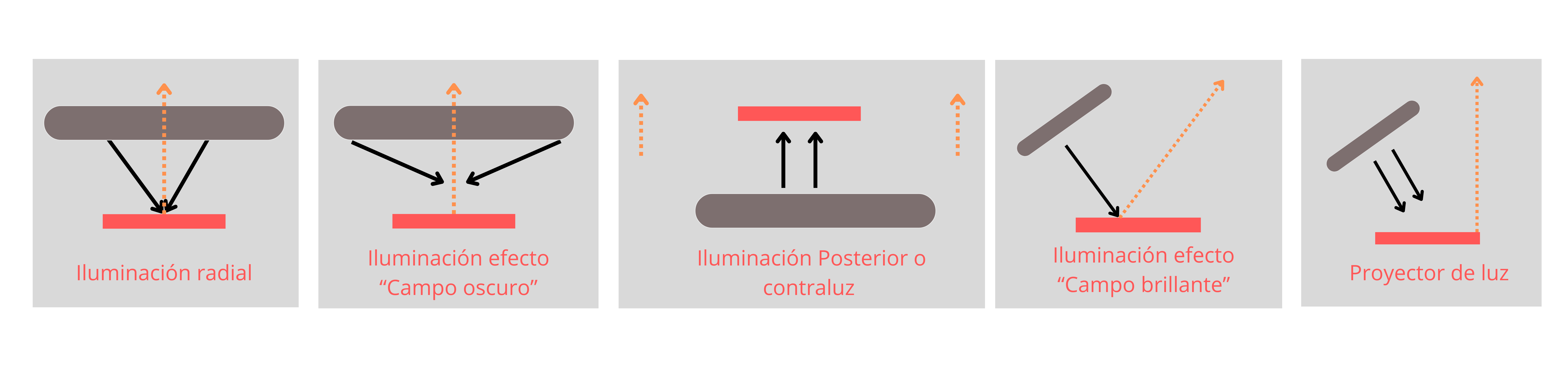
1. Radial Lighting
Radial lighting involves distributing light around the object under study from multiple directions. This type of lighting is useful for highlighting surface details of the object, as it illuminates from different angles, providing a complete and uniform view, reduces shadows and softens textures.
2. Effect Lighting
In dark-field lighting, light is removed from the direct field of view and focuses only on the object, creating strong contrast highlighting irregularities and contours. This effect is particularly useful for detecting defects or specific features on uniform surfaces.
3. Backlighting or Contra-illumination:
Backlighting or contra-illumination consists of placing the light source behind the object, illuminating from the back and creating a silhouette effect. This type of lighting highlights edges and shapes of the object, facilitating detection of fine details and small deformations.
4. Cloudy Day Effect Lighting
The “cloudy day” effect lighting provides soft, uniform light, similar to diffuse light on a cloudy day. This type of lighting is ideal for general inspections where soft lighting without pronounced shadows is required.
5. Bright Field Effect Lighting
In contrast to dark-field effect lighting, bright-field effect lighting involves evenly illuminating the entire surface of the object. This helps capture minute details and highlight the most subtle features of the object.
6. Light Projector
A light projector is a concentrated light source that emits a focused beam onto specific areas of the object. This type of lighting is useful for highlighting specific features or illuminating areas of interest within the field of vision.
7. Axial Lighting
Axial lighting involves directing the light from the same viewing angle as the camera. This helps highlight textures and details of the object by illuminating them from the same direction as the observation, enabling precise surface evaluation.
Light sources in machine vision systems can vary widely in their technology and characteristics. They can range from fiber optic to lasers, each with its own advantages and specific applications. Additionally, the possibility of using different light colors allows adapting to a wide range of materials and objects with varying reflection and absorption properties.
Regarding materials, understanding their characteristics is crucial for effective lighting. Specular materials reflect light similarly to a mirror, while diffuse materials scatter light in all directions. Reflective materials have a specific reflection direction, and spectral-selective materials reflect only certain wavelengths of light.
In Omnielectric, we understand the importance of choosing the right lighting technique for each computer vision application. That is why we offer a variety of product options. With our experience and the backing of leading suppliers, we can ensure you find the perfect lighting solution for your specific needs.
Do you need to talk to our experts?
Write to us at ventas@omnielectric.es