
Autonomous inspection in demanding environments
In the industrial sector, inspection of equipment and infrastructure remains an essential task to ensure safety, service continuity and operational efficiency. However, many environments present difficult conditions, such as high temperatures, noise, confined areas or hard-to-reach zones.
To address these challenges, quadruped robots are capable of performing autonomous and intelligent inspections, thanks to their dynamic stability, advanced sensors and artificial vision systems. These robots can safely move through complex environments and continuously collect data.
What is a quadruped robot and why it matters
A quadruped robot is a robotic system that moves on four articulated legs, imitating animal locomotion. Models developed such as those from Deep RoboticsThey stand out for their robustness, autonomy, and their ability to integrate vision systems, artificial intelligence (AI), and data analysis platforms.
These features make them strategic allies for Industry 4.0, providing mobility, adaptability and precision.
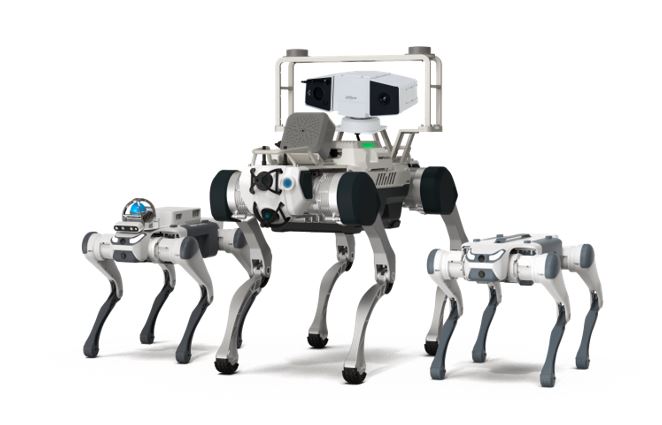
Main industrial use cases
1. Energy and utilities
In the energy sector, industrial quadruped robots enable inspections of infrastructures such as substations, power grids and generation plants; through autonomous inspection flows they can traverse predefined routes, collecting thermal and visual data in real time.
2. Rescue and emergencies
Quadruped robots play a crucial role in rescue missions or post-disaster situations thanks to their all-terrain mobility; they can access collapsed zones with smoke, rubble or toxic gases, transmitting live images and collecting temperature or gas data, and they can even transport essential supplies.
3. Tunnels and underground infrastructures
In tunnels and underground service networks they can traverse narrow corridors, climb slopes of up to 30°, and detect cracks or leaks with high-precision sensors.
4. Metals and mining
In the mining and metallurgical environment, characterized by conditions of dust, humidity and rough terrain, robots allow inspecting heavy machinery, wiring or underground areas.
5. Construction and surveying
In construction projects and civil works, Deep Robotics robots act as mobile lifting and 3D mapping platforms using scanners and autonomous navigation.
6. Research and education
In the academic and technological field, universities and innovation centers use Deep Robotics quadruped robots as open experimentation and development platforms. Their modular architecture supports custom programming integration of sensors and testing of artificial intelligence, vision or autonomous navigation algorithms.
Demonstration at Smart City Expo World Congress Barcelona

Omnielectric will participate together with Dahua Technology in the Smart City Expo World Congress which will be held in Barcelona from November 4 to 6, 2025.
During the event a demonstration will be held, where its operation in autonomous inspection and visual analysis tasks will be shown.